
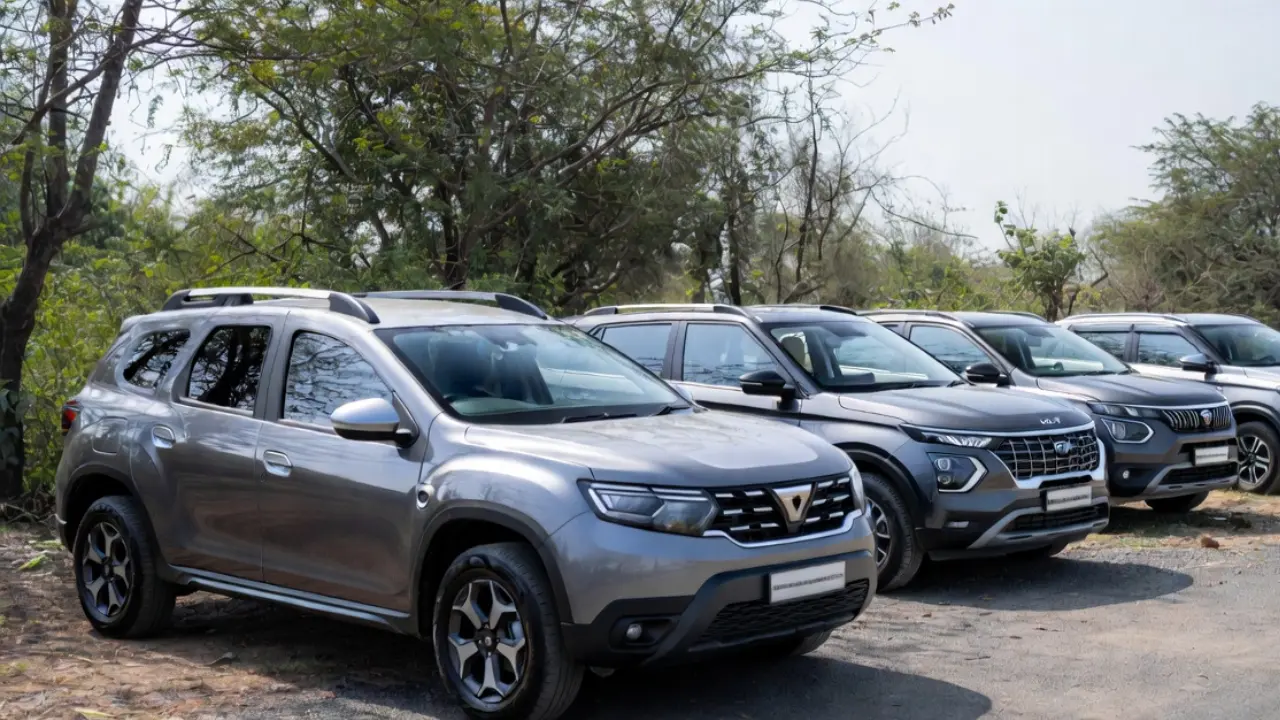
Renault has officially unveiled the new-generation Duster for India, marking the return of one of the most recognisable SUV nameplates in the country. With its fresh design, improved dimensions, and a broad range of powertrain options, the 2026 Renault Duster is being positioned as a rugged, practical midsize SUV with strong fundamentals.
The segment, however, is fiercely competitive. The new Duster goes up against established rivals such as the Hyundai Creta, Kia Seltos, Tata Sierra, and strong-hybrid offerings like the Maruti Suzuki Grand Vitara, Victoris, and Toyota Hyryder. Here’s a closer look at how the Duster stacks up against its key competitors.
Dimensions: Right in the Segment Sweet Spot
In terms of overall size, the new Renault Duster sits squarely in the heart of the midsize SUV segment. Measuring 4,346 mm in length, it is almost identical to the Grand Vitara and Hyryder (both 4,345 mm), slightly longer than the Hyundai Creta (4,330 mm) and Tata Sierra (4,340 mm), but still shorter than the Kia Seltos, which leads the pack at 4,460 mm.
Where the Duster starts to differentiate itself is width. At 1,815 mm, it is wider than the Creta (1,790 mm) and the Japanese hybrid SUVs (around 1,795 mm). Only the Seltos (1,830 mm) and Sierra (1,841 mm) are wider, giving the Duster a planted stance without being overly bulky.
Height is another area where the Duster leans into traditional SUV proportions. At 1,703 mm, it stands noticeably taller than both the Creta and Seltos (1,635 mm each), reinforcing its upright and rugged design philosophy.
The wheelbase measures 2,657 mm, which is longer than Creta (2,610 mm) and the hybrid trio (2,600 mm). However, Seltos (2,690 mm) and Sierra (2,730 mm) still lead in outright wheelbase length, suggesting slightly better rear-seat stretch potential.
Practicality: Boot Space and Ground Clearance Shine
Practicality is where the new Duster makes a strong case for itself. The headline number here is its 700-litre boot capacity, which is significantly larger than most rivals. For context, the Hyundai Creta offers 433 litres, while the Kia Seltos provides 447 litres. Boot capacity figures for the Grand Vitara, Victoris, and Hyryder have not been disclosed in the comparison table, but none are expected to come close to the Duster’s figure.
Ground clearance is another major highlight. With 212 mm of clearance, the Duster leads this comparison outright. It comfortably beats the Creta (190 mm), Seltos (200 mm), and even edges past the Sierra (205 mm). The hybrid SUVs trail closely at around 210 mm, but the Duster still takes the crown.
Wheel size further reinforces its premium positioning. The Duster rides on 18-inch wheels, matching the Seltos. The Creta and the Japanese hybrids use 17-inch wheels, while the Sierra goes one step further with 19-inch alloys.
Petrol Powertrains: Duster Takes the Lead
Under the hood, the new Renault Duster brings a wide and competitive range of petrol engines. The lineup includes a 1.0-litre three-cylinder turbo-petrol and a more powerful 1.3-litre four-cylinder turbo-petrol engine.
The larger turbo unit produces 163 PS of power and 280 Nm of torque, making the Duster the most powerful petrol SUV among its immediate rivals. In comparison, both the Hyundai Creta and Kia Seltos top out at around 158 hp, while the Tata Sierra’s turbo-petrol option is rated at 160 hp and 255 Nm.
Naturally aspirated petrol engines offered by some rivals sit significantly lower in terms of output, giving the Duster a clear advantage for buyers seeking performance.
Transmission options for the top-spec Duster turbo include a 6-speed manual and a dual-clutch automatic (DCA). While Creta and Seltos still offer a wider mix of gearboxes—including IVT, IMT, and DCT—the Duster’s focus appears to be on robust, driver-oriented setups.
Hybrid Future on the Horizon
Adding to its appeal, Renault has confirmed that a strong-hybrid version of the Duster will be introduced later in 2026. This will allow it to directly challenge hybrid-focused rivals like the Grand Vitara, Victoris, and Hyryder, while offering buyers an alternative that blends efficiency with traditional SUV toughness.
Verdict: Back to SUV Basics
The new Renault Duster positions itself as a no-nonsense SUV with strong fundamentals—excellent ground clearance, class-leading boot space, competitive dimensions, and the most powerful petrol engine in its segment. While rivals may offer more transmission choices or feature-loaded cabins, the Duster’s focus on space, stance, and performance gives it a distinct identity.
For buyers who value real-world practicality and rugged capability alongside modern powertrains, the new-generation Duster makes a compelling comeback.