
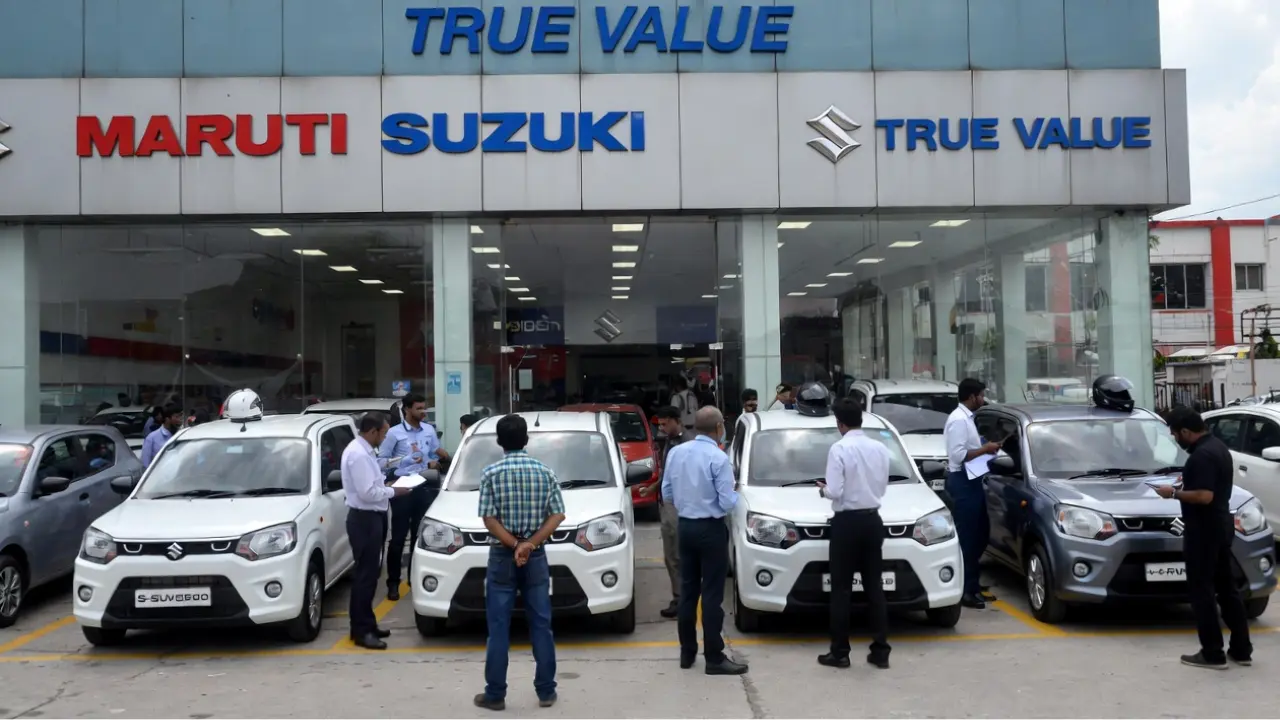
Maruti Suzuki is witnessing a significant turnaround in demand for entry-level cars in India, marking a positive shift after a prolonged slowdown in the small-car segment. The revival has been driven largely by first-time buyers, improved affordability following GST reforms, and a renewed trend of two-wheeler owners upgrading to cars.
Speaking during Maruti Suzuki’s Q3 FY2026 earnings call, Rahul Bharti, Executive Officer – Corporate Affairs, highlighted the scale of the recovery. He noted that small cars, which were previously experiencing negative growth, have now moved firmly into positive territory. “Small cars were earlier in a negative growth zone. They have moved from red into black and healthy black, and that swing is actually larger than what we are seeing in bigger cars,” Bharti said.
First-Time Buyers Drive Demand Upswing
One of the most notable contributors to the rebound is the sharp increase in first-time car buyers. According to Maruti Suzuki, the share of first-time buyers has risen from around 40 percent to nearly 47 percent, underlining renewed confidence among entry-level customers.
Bharti described this trend as a “very healthy sign” for the Indian automobile market. He also pointed to anecdotal evidence suggesting a strong upgrade cycle from two-wheelers to small cars. “We are seeing a lot of helmets in our showrooms,” he remarked, indicating that many customers are arriving directly from two-wheeler ownership.
This shift reflects changing consumer aspirations, greater affordability, and the growing appeal of compact cars as safer and more comfortable alternatives to two-wheelers, especially for urban and semi-urban buyers.
GST Reform Boosts Affordability
A major catalyst behind the resurgence in entry-level car demand has been the 2025 GST reform, which significantly improved affordability. Under the revised GST structure, small cars measuring under four metres in length and powered by petrol engines below 1,200cc or diesel engines under 1,500cc were moved to the 18 percent GST slab, down from the earlier 28 percent.
The impact was immediate and substantial. Several Maruti Suzuki models witnessed price reductions of up to Rs 1.3 lakh after the GST cut came into effect in September 2025. These reductions played a crucial role in bringing cost-sensitive buyers back into the market.
As a result, the Maruti S-Presso has now replaced the Alto K10 as the most affordable car currently on sale in India, strengthening Maruti Suzuki’s position in the entry-level segment.
Stable Pricing Supports Momentum
In addition to GST-led price cuts, Maruti Suzuki has also maintained stable pricing despite fluctuations in input costs. The company confirmed that prices have been held steady so far to sustain demand momentum, even as raw material prices remain volatile.
Bharti stated that pricing remains under continuous review and that any revisions will be carefully evaluated in the coming weeks, once the current order book is serviced.
Record Sales and Strong Financial Performance
The revival in entry-level demand has directly contributed to Maruti Suzuki’s record-breaking sales performance. During Q3 FY2026, the company sold 5,64,669 vehicles domestically, marking its highest-ever quarterly domestic sales. This represented a year-on-year increase from 4,66,993 units.
Entry-level cars accounted for over 12 percent of total sales, contributing 68,328 units to the incremental volume during the quarter.
Financially, Maruti Suzuki reported a 4.1 percent YoY increase in net profit, reaching Rs 3,879 crore, while revenue surged 28.7 percent to Rs 49,904 crore, the fastest growth rate in more than three years. For the April–December FY2026 period, the automaker posted its highest-ever nine-month sales volume, net sales, and net profit.
Capacity Expansion to Address Supply Constraints
The sharp rebound in demand has also highlighted supply limitations. Dealer inventory levels have fallen to just three to four days, while the company’s order book currently stands at around 1,75,000 vehicles, clearly indicating supply constraints rather than weak demand.
To address this, Maruti Suzuki is accelerating its capacity expansion plans. The automaker plans to add approximately 5 lakh units of annual manufacturing capacity over the next year through new facilities and line expansions.
This includes a second plant at Kharkoda, scheduled to begin operations by April 2026, and a fourth manufacturing line at the Gujarat plant. Each facility will contribute around 2,50,000 units of additional annual capacity, helping Maruti Suzuki meet rising demand across segments, especially at the entry level.