
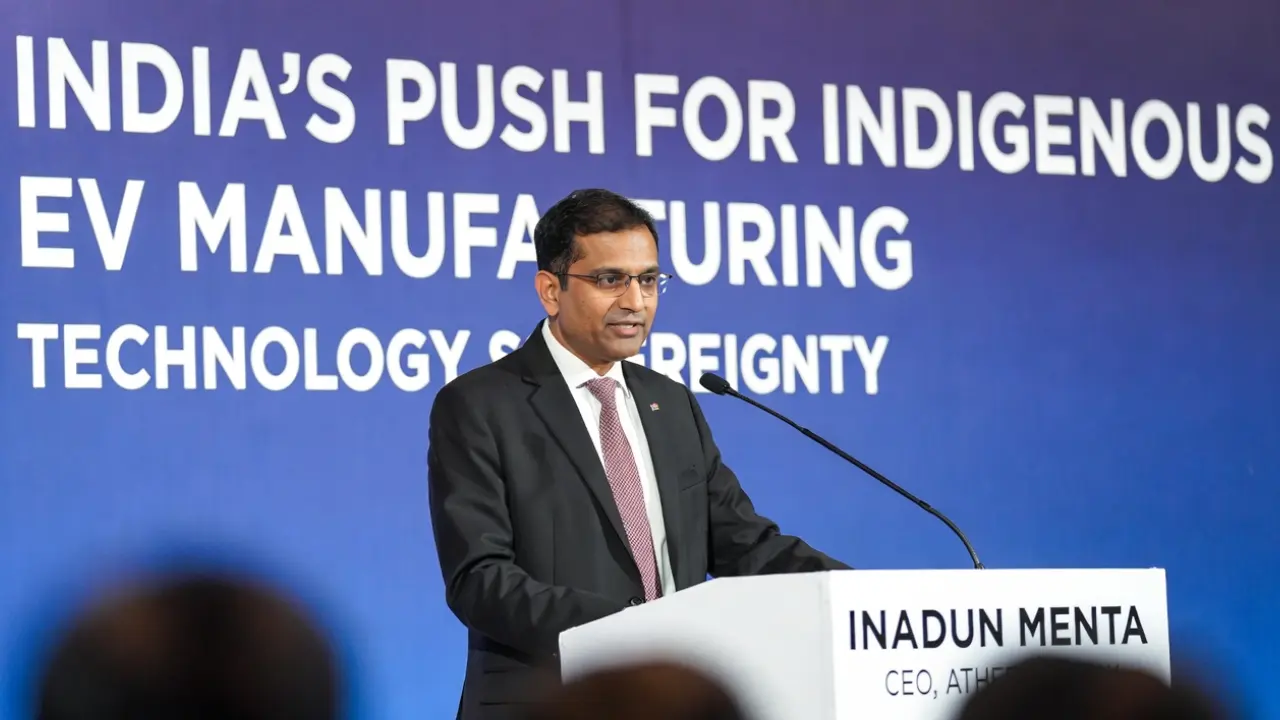
Bengaluru: India’s electric vehicle (EV) ecosystem is undergoing a fundamental transformation, moving steadily away from import dependence toward indigenous manufacturing and deep technological capability. What was once an assembly-driven model reliant on overseas components is now evolving into a system focused on design, engineering, machine-building, and technology sovereignty. According to Tarun Mehta, Co-founder and CEO of Ather Energy, this shift will determine whether India becomes a true global EV powerhouse or remains a contract manufacturing base.
Speaking at the inaugural session of the IMTEX Forming 2026 exhibition in Bengaluru, Mehta outlined how India’s EV future hinges not merely on local assembly, but on building end-to-end domestic capability across critical technologies, manufacturing processes, and production equipment.
Localisation as a Strategic Imperative
Over the past decade, localisation in India’s EV sector has transitioned from a cost-saving measure to a strategic necessity. Policy initiatives such as Make in India, Production-Linked Incentive (PLI) schemes, and growing geopolitical uncertainties have underscored the risks of excessive reliance on imported components—particularly from a limited set of global suppliers.
Components that were once largely imported, including battery packs, motors, power electronics, controllers, and key EV sub-systems, are increasingly being designed and manufactured within India. This shift, Mehta noted, is critical for supply chain resilience, long-term competitiveness, and national technological independence.
“Technology sovereignty is not optional anymore,” Mehta said. “If we don’t control the core technologies and manufacturing processes behind EVs, we will always remain vulnerable to global disruptions.”
From Scarcity to Scale in EV Components
Reflecting on Ather Energy’s early journey, Mehta highlighted how dramatically the ecosystem has changed. “When we started, lithium battery manufacturers in India were almost non-existent. Motors, motor controllers, and power electronics were largely imported, and most of the EV supply chain lived outside the country,” he explained.
Today, many of these components have become widely available within India, supported by a growing base of domestic suppliers. However, Mehta stressed that this evolution did not happen overnight.
“This progress is the result of more than a decade of sustained localisation efforts,” he said, crediting early supplier partners who took risks and invested in EV technologies long before volumes were guaranteed.
The impact of this commitment is especially visible in metallic components such as castings, forgings, and welded assemblies, where Indian manufacturing has developed both scale and sophistication.
Manufacturing Innovation Enables Product Innovation
One of the strongest examples of how indigenous manufacturing enables product-level innovation is Ather’s hybrid aluminium chassis, which Mehta described as a global first in the scooter segment.
“No scooter in production—whether in India or internationally—uses this kind of hybrid aluminium chassis,” he said. “It was designed, tooled, and manufactured entirely in India, and it represents a contrarian approach to scooter design.”
While aluminium frames offer advantages in weight reduction and performance, Mehta pointed out that they have traditionally been limited to low-volume or niche products due to manufacturing constraints. Making such a chassis viable at scale required significant innovation in high-pressure die casting, tooling, and process control.
“Without manufacturing innovation, design innovation doesn’t scale,” he emphasised. “You can have the best design in the world, but if you can’t manufacture it efficiently and consistently, it won’t succeed.”
The Importance of Machine-Building Capability
Beyond component localisation, Mehta placed strong emphasis on machine-building capability—the ability to design and manufacture the machines that make EV components.
True technology sovereignty, he argued, comes not just from making parts locally, but from owning the knowledge and equipment used to produce them. Countries that lead in advanced manufacturing do so because they control their production technologies, not just final assembly lines.
“If we depend on imported machines to make locally designed products, we are still dependent,” Mehta noted. “The next phase of India’s EV journey must focus on building machines, tools, and manufacturing intelligence within the country.”
Building a Globally Competitive EV Ecosystem
According to Mehta, India is now at an inflection point. The foundational capabilities—engineering talent, supplier base, and manufacturing scale—are largely in place. What’s needed next is sustained investment in deep-tech manufacturing, materials science, automation, and precision engineering.
Such efforts will not only reduce import dependence but also position India as a global exporter of EV technology, rather than just finished vehicles.
Conclusion
Tarun Mehta’s vision underscores a crucial truth about India’s EV ambitions: success will not be defined by how many vehicles are assembled locally, but by how much technology, manufacturing know-how, and production intelligence are truly homegrown.
As India accelerates toward an electric future, the shift from import dependence to indigenous capability may well determine its standing in the global EV value chain—not just as a market, but as a leader.