
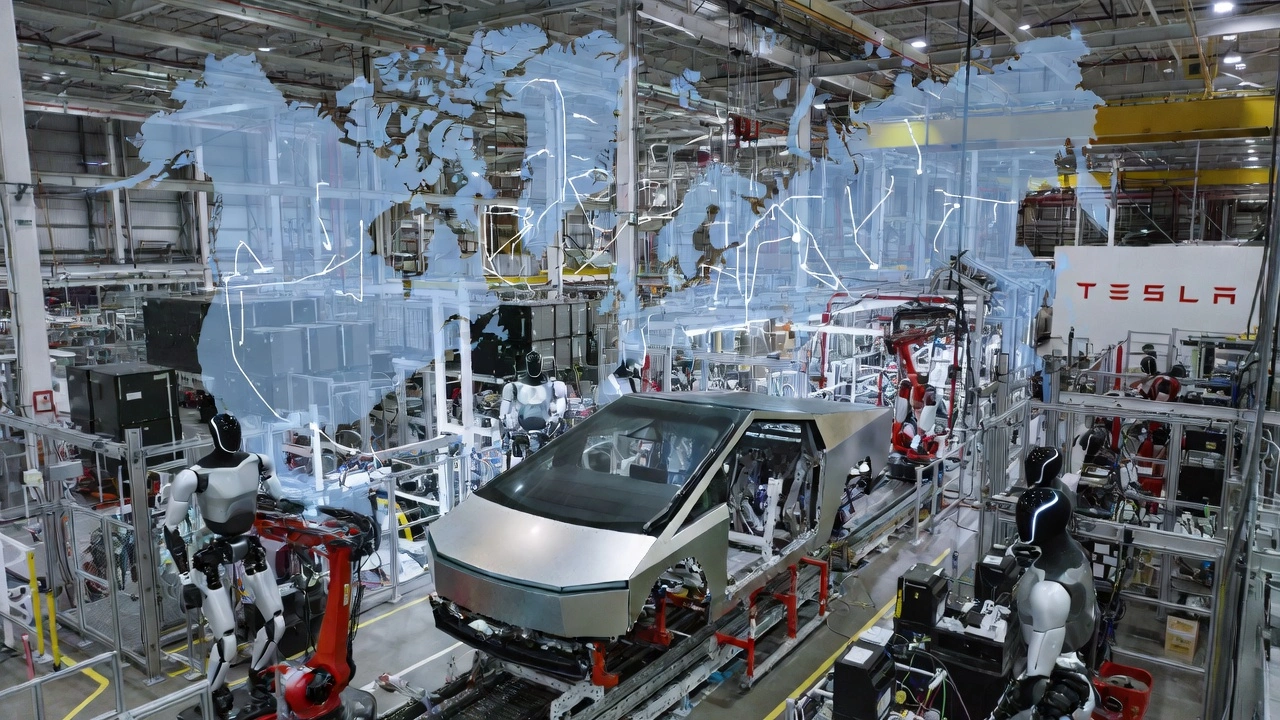
As 2026 begins, Tesla Inc. stands at one of the most consequential moments in its history. Once known almost exclusively as the world’s most influential electric vehicle (EV) maker, Tesla is now attempting a bold transformation into an artificial intelligence, robotics, and energy powerhouse. This strategic pivot comes at a time of growing uncertainty: global EV demand has slowed, geopolitical tensions are rising, and a new trade conflict tied to Arctic mineral resources threatens to disrupt the global battery supply chain.
With a market capitalization hovering near $1.46 trillion, Tesla is no longer just a car company. It has become a trillion-dollar wager on autonomous mobility, AI-driven labor, and next-generation energy infrastructure.
From EV Pioneer to AI-First Company
Founded in 2003 and shaped early on by Elon Musk, Tesla’s rise reshaped the automotive industry. Vehicles like the Model 3 and Model Y proved that EVs could be mass-market, profitable, and desirable. Between 2020 and 2022, Tesla’s valuation surged past $1 trillion as it expanded manufacturing across the U.S., China, and Europe.
However, the era of rapid EV expansion has faded. Following intense global price wars in 2024 that compressed margins industry-wide, Tesla entered what many analysts now call its “Intelligence Era.” Instead of focusing solely on vehicle deliveries, the company has shifted toward software, automation, and recurring revenue streams centered around autonomy and robotics.
A Three-Part Business Model
Tesla’s business today rests on three core pillars:
Automotive: Vehicle sales remain Tesla’s largest revenue source, including the Model S, 3, X, Y, and Cybertruck. However, margins have narrowed to roughly 17% by late 2025 as competition intensifies.
Energy Generation and Storage: Products such as Powerwall and Megapack have become Tesla’s fastest-growing segment. In 2025, energy deployments reached 46.7 GWh, providing stability as vehicle growth slowed.
Services and AI Software: This includes Full Self-Driving (FSD) subscriptions, Supercharging revenue from other automakers, and early-stage robotics services linked to Optimus.
Stock Performance and Financial Snapshot
Tesla’s stock performance reflects both optimism and uncertainty. Over the past year, shares are down around 8%, pressured by weaker deliveries and questions surrounding the April 2026 Cybercab launch. Over five years, however, Tesla remains up more than 140%, far outperforming broader markets.
For fiscal year 2025, Tesla generated an estimated $96.3 billion in revenue, with vehicle deliveries slipping to 1.63 million units. Looking ahead, 2026 projections suggest moderate growth to $108 billion in revenue, though heavy investments in AI infrastructure and robotics manufacturing are expected to weigh on free cash flow.
Tesla currently trades at a forward P/E exceeding 200x, reflecting investor belief that autonomy and robotics will eventually unlock massive new revenue streams.
Leadership and Execution Risk
Elon Musk remains Tesla’s defining force, but his attention is increasingly divided between Tesla, SpaceX, and X. While senior executives such as Tom Zhu and Ashok Elluswamy provide operational stability, investor concerns around governance and leadership focus persist.
Innovation at the Core
Tesla’s near-term future hinges on two technologies:
Optimus Humanoid Robot: By early 2026, more than 1,000 Optimus units are reportedly operating within Tesla factories. The latest generation features advanced dexterous hands designed for precision tasks, signaling progress toward commercial viability.
Full Self-Driving Software: Tesla’s latest FSD version introduces reasoning-based neural networks, pushing closer to Musk’s goal of unsupervised autonomy later in 2026.
Meanwhile, Tesla’s Megapack energy systems continue to dominate utility-scale storage markets, with multi-year backlogs from grid operators worldwide.
Competition on Two Fronts
Tesla now faces pressure from both sides. In EVs, Chinese manufacturers like BYD and Xiaomi are delivering affordable, high-quality vehicles at scale. In AI, Tesla competes with Waymo, Nvidia, and other deep-pocketed technology players.
Tesla’s key advantage remains its unmatched real-world driving data, generated by millions of vehicles globally.
The Arctic Trade Wildcard
Perhaps the biggest unknown for 2026 is geopolitics. Rising tensions between the U.S. and Europe over Greenland’s critical mineral reserves have triggered new tariffs that could raise Tesla’s costs by 4–6%. Tesla’s long-term battery strategy depends on securing lithium and rare earth materials while complying with U.S. domestic sourcing rules — a delicate balancing act.
What Investors Are Watching
Two events could define Tesla’s trajectory in 2026:
- The April Cybercab unveiling, which must prove fully driverless capability and a viable cost model
- Trade developments tied to Arctic mineral access, which could reshape Tesla’s supply chain economics
Final Outlook
Tesla in 2026 is no longer a straightforward EV growth story. It is a high-risk, high-reward bet on the convergence of AI, energy, and automation. While trade tensions and margin pressure pose real threats, Tesla’s leadership in real-world AI and energy storage gives it a defensive edge few competitors can match.
The success—or failure—of this pivot will determine whether Tesla defines the next technological era, or becomes a cautionary tale of ambition outpacing execution.